Creating a company in Andorra: fire extinguisher and safety signage, what are the requirements?
Creating a company in Andorra is not limited to choosing a legal structure, depositing the required capital or completing the registration procedures. As soon as an activity is carried out on business premises, another issue must be anticipated: compliance of the premises, particularly with regard to fire safety. A fire extinguisher and its signage may seem like minor details when preparing to open a business. In practice, they are part of a broader set of measures designed to ensure the safety of occupants and make emergency equipment immediately accessible in the event of a fire.
However, the applicable requirements are not the same for all premises. An office, a retail premises open to the public, a restaurant and a workshop do not present the same risks or necessarily have the same requirements. The size, layout, nature of the activity, equipment present and characteristics of the building must all be taken into account. Before purchasing a fire extinguisher or fixing a sign to the wall, determine precisely which rules apply to the premises concerned.
Andorran company: elements to plan for beyond registration
Andorra attracts entrepreneurs who wish to develop a business between France and Spain. The country has a tax system that differs from those of its European neighbours. Its corporate income tax has a general maximum rate of 10%, while its general indirect tax, IGI, is presented with a standard rate of 4.5%.
However, these tax considerations should not overshadow the other aspects of setting up a business in Andorra. Establishing a company involves legal and administrative procedures and, depending on the activity, checks relating to the business premises.
Choosing the legal structure is one of the first decisions to be made. The Societat Limitada, or SL, is generally used for small and medium-sized businesses, while the Societat Anònima, or SA, is intended for projects of a different scale. The incorporation requirements, required capital and applicable procedures should be verified when planning the project, as regulations may change.
The situation also differs depending on whether the entrepreneur is a resident or non-resident and on the origin of the capital. A project involving foreign investment may require specific formalities. This is in addition to the question of where the business will actually be carried out. It is at this stage that compliance of the premises, particularly fire protection, becomes important.
Fire safety designed around the premises and the activity
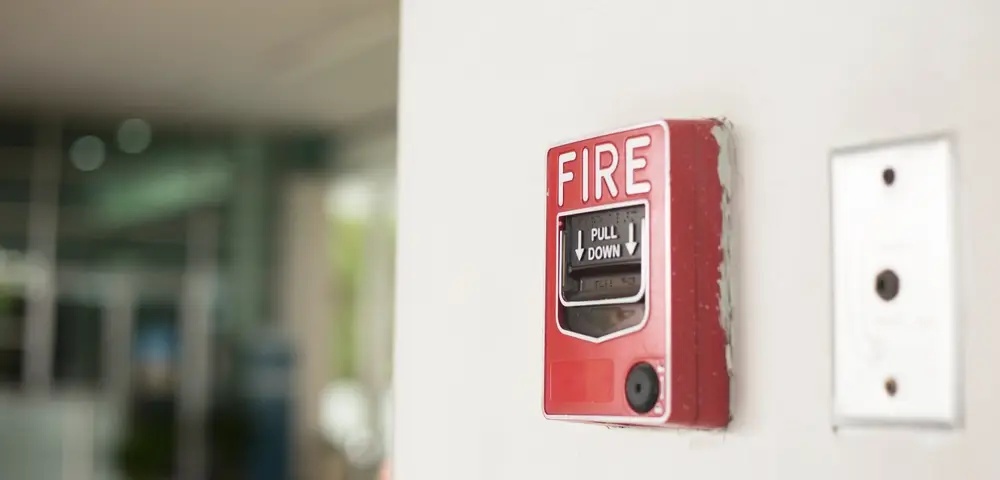
Compliance of a premises depends on its actual configuration. A small administrative office does not present the same risks as a professional kitchen, a workshop using electrical equipment or an area where flammable products are stored. The number and type of fire extinguishers required must be determined according to the risks present.
The size of the premises also matters. Its layout, evacuation routes, accessibility of emergency equipment and the possible presence of members of the public may affect the measures that need to be put in place.
For an entrepreneur, the right approach is to assess fire safety sufficiently early, ideally before the premises officially open. This helps avoid purchasing unsuitable equipment or having to modify an installation at the last minute.
Fire extinguisher for a business in Andorra: how to choose the right equipment?
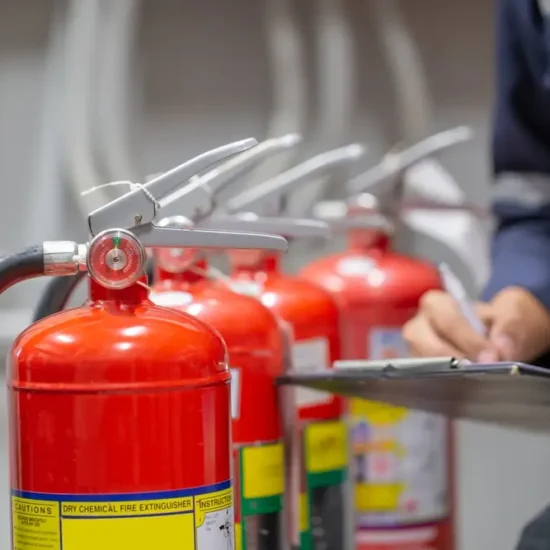
A fire extinguisher is only truly useful if it is suitable for the type of fire that could occur on the premises. The risks encountered in a standard office, for example, differ from those found in a professional kitchen or workshop. Depending on the situation, different extinguishing agents may be used, particularly water with additive, powder or CO₂.
Choosing solely based on the price or size of the equipment is not appropriate. A fire protection professional can assess the layout of the premises, identify the main risks and determine the type, capacity, number and location of the equipment required. This assessment is particularly useful when the premises are open to the public, consist of several rooms, include a kitchen, contain technical installations or are used for an activity involving a specific risk.
Accessibility is just as important as choosing the right equipment. A fire extinguisher placed behind a piece of furniture, in a locked room or somewhere difficult to identify loses much of its usefulness in an emergency. The objective is simple: anyone present on the premises should be able to quickly locate the equipment and access it without obstruction.
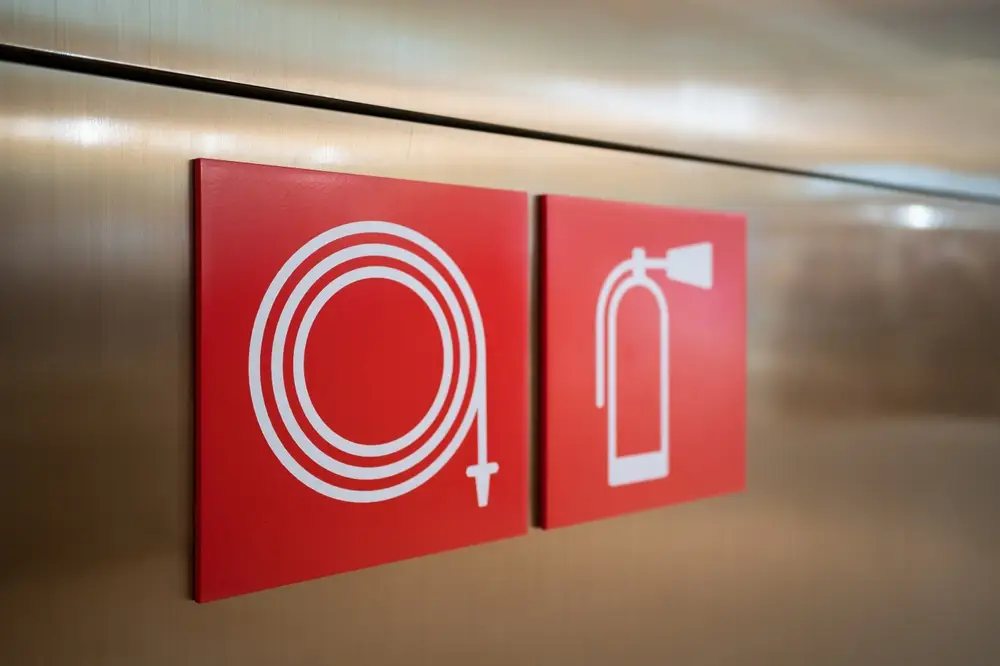
The importance of fire extinguisher signage
Signage is not simply a decorative element placed above the fire extinguisher. Its purpose is to enable immediate identification of firefighting equipment. Under normal circumstances, a fire extinguisher is easy to notice. In the event of a fire, smoke, stress, the presence of other people or reduced visibility can make finding it much more difficult. Properly positioned signage can therefore help locate the equipment more quickly.
The pictogram used must be easy to understand and sufficiently visible. Depending on the layout of the premises, photoluminescent signage may also be useful when lighting becomes insufficient. Above all, the situation must be considered in real-life conditions. If a shelf, an open door or part of the layout completely conceals the sign from the circulation area, simply having it on the wall may not be enough to ensure effective signage.
The exact height and positioning should be determined in accordance with the requirements applicable to the premises and the equipment installed. Rather than relying on a universal height without considering the specific context, it is preferable to have the installation checked when there is any doubt.
Home office: is it automatically subject to the same requirements?
This question deserves particular attention, as working from home does not necessarily mean that all the rules applicable to a professional establishment open to the public apply in exactly the same way. A distinction must be made between simply using a home as the company's registered address, actually carrying out a professional activity from home, receiving clients or employees, and using part of the property as a genuine business premises. These situations may result in different requirements.
When should you check fire safety compliance?
Fire safety in the premises should ideally be assessed before they open. Waiting until all the procedures have been completed to discover that equipment needs to be added, relocated or replaced can delay the project. Once the premises have been identified, an early assessment makes it possible to determine which measures need to be incorporated into the layout.
Documentation relating to installations and their maintenance should be kept whenever required. Depending on the situation, the relevant documents may include the technical specifications of the equipment, certificates issued by the professionals involved, inspection reports or maintenance records.
However, the exact documents required depend on the administrative procedure and the activity concerned. It should not be assumed that a fire extinguisher invoice or an evacuation plan is systematically a mandatory document for every company incorporation.
It is preferable to check which documents are actually required for the relevant authorisation or opening with the competent authorities or a professional familiar with Andorran regulations.
Maintenance: a point as important as installation
Purchasing a compliant fire extinguisher when the premises open does not permanently resolve the issue of fire safety. Equipment must remain accessible, identifiable and operational over time. Inspections and maintenance operations make it possible to check its condition, integrity and ability to function properly when needed.
Signage deserves the same attention. A damaged sign, one that has been concealed following a renovation or one that has become difficult to see must be corrected.
For the company, it is useful to keep the documents provided during inspection and maintenance operations. This record-keeping makes it possible to track the history of the equipment and have the necessary documentation available when requested. The frequency and nature of inspections should be determined based on the requirements applicable to the equipment installed and the type of establishment.
What happens in the event of non-compliance?
Inadequate fire safety installations can have administrative consequences and, above all, create a real risk for people present on the premises. The seriousness of a non-compliance depends on many factors: the nature of the breach, the activity carried out, the level of risk, the type of establishment and the circumstances in which the issue is identified.
This is why caution is needed when dealing with fines presented as automatically applicable to the absence of a fire extinguisher or sign. Without a precise reference to the legislation in force and the classification of the offence, stating a fixed penalty or universal range may mislead the entrepreneur.
When a problem is identified, the priority is to precisely determine the issue and have it corrected by a qualified professional when the intervention requires it. Documentation confirming that the issue has been resolved should then be retained.
Compliance should not, moreover, be considered solely from the perspective of administrative inspections. A properly selected, maintained and signposted fire extinguisher can make it possible to deal with a fire at an early stage before it spreads. This is above all why this equipment should be taken seriously.

Realize your expatriation project without further delay!
Make an appointment
Mistakes to avoid before opening your business
The most common mistake is to purchase a fire extinguisher at random simply to be able to say that the premises have one. Equipment that is unsuitable for the identified risk can create a false sense of security.
Another mistake is to install the equipment correctly and then neglect its accessibility. Over time, a piece of furniture, stock or a new layout may conceal the fire extinguisher or its signage.
You should also avoid assuming that a rule found for a restaurant, retail premises or workshop automatically applies to an office. Fire safety regulations are closely linked to the nature of the premises and the risks involved.
Finally, entrepreneurs should keep documentation relating to their equipment. A compliant installation that cannot be properly documented may make a subsequent inspection more complicated.
Check the rules applicable to your business in Andorra
The first step is to clearly define how the premises will be used. You need to know what activity will be carried out there, what area will be used, whether employees or customers will be present and what specific risks exist. Based on this information, it becomes possible to determine the necessary protective measures and check the applicable requirements.
For regulatory matters, the primary source should remain the official legislation in force and information published by the relevant Andorran authorities. When a technical assessment is required, particularly to determine the type or location of a fire extinguisher, involving a qualified fire protection professional makes it possible to compare regulatory requirements with the actual characteristics of the premises. This precaution is all the more important because regulations can change.
Key takeaways on fire extinguishers and signage in Andorra
Setting up a company in Andorra involves administrative, tax and legal considerations, but also requirements relating to the premises where the business will operate.
When fire protection is required, it is not enough to purchase the first available fire extinguisher and hang a pictogram on the wall. The equipment must be suitable for the risks present on the premises, remain accessible, be properly signposted and receive the necessary maintenance and monitoring.
Above all, universal rules presented without context should be avoided. The requirements for an office, restaurant, retail premises, workshop or activity carried out from home may differ.
Before opening, the safest approach is to check the official legislation currently in force and, where the configuration of the premises warrants it, have the installation assessed by a qualified professional in Andorra. This approach ensures that fire safety is treated for what it really is: a measure designed to protect people and the business, rather than simply another box to tick when setting up a company.