What languages are spoken in Andorra?
When you decide to live in a new country, your lifestyle changes. New eating habits may be necessary and sometimes even new clothing styles. But, there is also the language. Sometimes it is necessary to learn the official language of the host country. For Andorra, this is Catalan. Although Spanish, French, Portuguese and English are also spoken in Andorra, its government is keen to promote it. In fact, even though it is a French-Catalan co-principality, being governed by the President of the French Republic and the Bishop of Urgell, French is not considered an official language, but only Catalan.
In Andorra, hearing several languages over the course of a single day is nothing unusual. In a shop, restaurant, or school, a conversation that begins in Catalan may continue in Spanish or French depending on the person you are speaking to. Portuguese is also widely present, while English is becoming increasingly common in tourism and international business. However, this diversity can create some confusion about the actual status of these languages. Legally, the situation is clear: Catalan is the only official language of the Principality of Andorra. Spanish, French, and Portuguese play an important role in everyday life, but they do not have the same institutional status. Understanding the languages spoken in Andorra therefore requires distinguishing between two realities: the country’s official language and the languages actually used by a highly international population.
Catalan, the only official language of Andorra
The status of Catalan is enshrined in the 1993 Andorran Constitution. Article 2 establishes Catalan as the official language of the State. It is therefore used in public institutions, administration, official documents, and much of the country’s institutional life. The legislative framework governing the use of Catalan also reinforces its position in the public sphere.
This distinction is important because the country’s geographical proximity to France and Spain can give the impression that French or Spanish have a comparable status. This is not the case. Their presence is primarily linked to the country’s history, migration, economic relations with neighboring countries, and the composition of its population.
In practice, someone moving to Andorra can regularly use Spanish, French, or Portuguese in their everyday life. For administrative procedures and institutional matters, however, Catalan retains a central role.
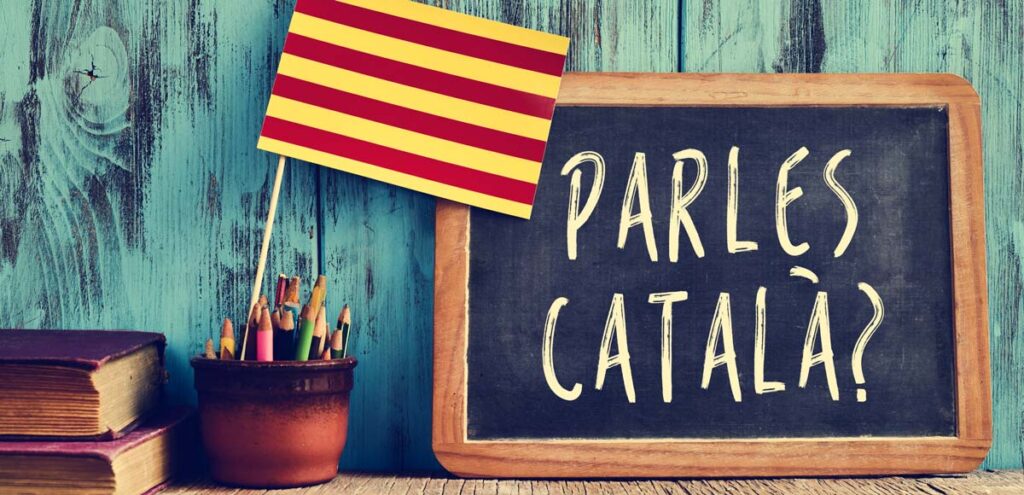
The main languages used in Andorra
The Andorran linguistic landscape is much more diverse than the official status of Catalan might suggest. Available demographic and linguistic data show a significant presence of Catalan and Spanish, alongside Portuguese and French in particular. This diversity is largely explained by the various waves of migration that shaped the country’s population throughout the 20th century.
The figures cited in the data presented here put Catalan at around 38% of primary home-language use, Spanish at around 35%, Portuguese at around 15%, and French at around 6%. Other languages account for approximately 6%.
These proportions should primarily be understood as a snapshot of the linguistic landscape rather than as a strict division between separate groups. The same person may use Catalan at work, Spanish with friends, and a third language at home. It is precisely this ability to switch between languages that characterizes part of everyday life in Andorra.
A linguistic diversity shaped by history
Catalan is deeply rooted in the history of the Principality. Present in the Pyrenees for centuries, it has long been used in everyday life as well as in various administrative, religious, and legal documents.
The country’s linguistic situation gradually became more diverse as economic and social ties with France and Spain developed. This change became particularly visible during the 20th century. Andorra’s economic growth attracted many workers and families, particularly from Spain, Portugal, and France. These migrations permanently transformed the composition of the population and, consequently, language use.
Catalan nevertheless retains a major institutional and cultural role. The 1993 Constitution officially established it as the language of the State, while various language policies aim to promote its learning and use.
The Catalan spoken in Andorra is part of the broader Catalan language while displaying certain local characteristics in vocabulary, pronunciation, and usage, reflecting the territory’s Pyrenean history and its constant contact with neighboring languages.
Catalan in Andorran identity and cultural life
In Andorra, Catalan serves more than just an administrative function. It is also one of the main markers of the country’s cultural identity. Its presence can be seen in institutions, local media, cultural events, literature, and popular traditions. Festivals held in the different parishes, community activities, and a significant part of cultural production all contribute to maintaining its use in everyday life.
The situation is particularly interesting because this effort to preserve Catalan takes place within a highly international society. The language therefore plays a dual role: preserving historical continuity while also serving as a common language for residents from a wide range of backgrounds.
For someone planning to live in Andorra permanently, learning Catalan is not simply an administrative necessity. Proficiency in the language facilitates professional and social integration as well as a better understanding of local culture. This does not mean that other languages disappear from everyday life. Quite the opposite: multilingualism is an integral part of how the country actually functions.
Multilingualism in everyday life
The language used in Andorra depends greatly on the context.
Catalan
In public administration, Catalan is the reference language. In shops, hotels, and restaurants, communication can be much more flexible. Staff accustomed to welcoming both residents and foreign visitors frequently switch from one language to another.
Spanish
Spanish is widely used in informal conversations, at work, and in many families. Its proximity to Catalonia and the historical importance of immigration from Spain largely explain its strong presence.
French
French naturally features in activities related to tourism and exchanges with France. Its presence is particularly noticeable in areas that welcome many French visitors, especially around Pas de la Casa and the French-Andorran border.

Realize your expatriation project without further delay!
Make an appointment
Portuguese
Portuguese is also part of the country’s linguistic landscape due to the significant Portuguese-origin community living in Andorra.
English
English is less established in family settings, but it is becoming increasingly useful in hospitality, international tourism, and certain professional environments.
The language heard most often therefore varies considerably depending on the location, professional sector, age of the people involved, and their family background. It would be reductive to look for a single “street language” that applies across the entire country. This reality gives Andorra a rather distinctive linguistic environment: the country has a clearly defined official language while everyday life takes place in several languages.
Three education systems and several languages of instruction
One of the most interesting features of Andorra is its education system. The country has three education systems: Andorran, French, and Spanish.
In the Andorran system, Catalan naturally plays an essential role. Students are also exposed to several other languages, including Spanish, French, and English.
The French system provides most of its instruction in French, while the Spanish system is based on Spanish. Catalan nevertheless remains part of the educational curriculum because of its status as the country’s official language.
This coexistence creates an environment in which many children are exposed to several languages from an early age. Depending on their school, family, and daily activities, they may hear and use Catalan, French, or Spanish in different contexts.
Multilingualism is not limited to children. Catalan-learning programs are also available to new residents, allowing them to improve their language skills and facilitate their integration. For a family considering moving to Andorra, the choice of education system therefore has a direct influence on the child’s linguistic environment.
The most useful languages for living in Andorra
Catalan remains the language to prioritize when planning a long-term move to the country. It provides access to public administration, institutional life, and an important part of the local culture.
Spanish is extremely useful in everyday interactions. Someone who speaks it will be able to communicate with a large part of the population in shops, at work, and in informal situations.
French is also a real advantage, particularly in tourism, retail, and relations with France. Portuguese, meanwhile, reflects the country’s migration history and remains clearly present among certain families and professional communities.
English is gradually becoming part of this linguistic environment, especially in sectors catering to an international clientele.
In practice, it is therefore not essential to speak all of these languages immediately when visiting Andorra. The situation is different when it comes to long-term relocation: learning Catalan makes it possible to go beyond basic practical communication and become more involved in the country’s social and cultural life.
Official language and languages used in everyday life in Andorra
Andorra’s linguistic situation becomes much easier to understand once a distinction is made between the legal framework and everyday practice. Catalan is the only official language of the Principality of Andorra. It is the language of the institutions and plays an essential role in the country’s national identity.
Spanish is nevertheless very widely used in everyday life. Portuguese has a significant presence due to the country’s migration history, while French remains particularly visible in tourism, retail, and cross-border relations.
This coexistence does not necessarily weaken the role of Catalan. Rather, it reflects the reality of a small state located between two major European countries whose population has been shaped by several generations of migration. This is what makes Andorra’s linguistic landscape so distinctive: one official language, but several languages that are genuinely alive in everyday life.