
Living in Andorra as an expatriate: embassies, consulates and procedures to know
Moving to Andorra is not just about finding accommodation and obtaining a residence permit. When living abroad, a question often eventually arises: who should you contact when you need to renew a passport, complete a civil status procedure or request emergency consular assistance? Andorra’s situation is quite unique. Due to the country’s small size and its proximity to France and Spain, not all nationalities have a full diplomatic representation in the Principality.
This is something worth anticipating even before moving. When a document expires or a passport is lost, discovering at the last minute that you need to travel to Barcelona, Madrid, Toulouse or another city can quickly make the situation more complicated. In this guide, we take a look at how consular assistance works for people living in Andorra and the precautions you should take to avoid unpleasant surprises.
Moving to Andorra: first understand your residency status
Before discussing consulates, it is important to distinguish between procedures handled by the Andorran authorities and those that depend on your country of origin. The right to reside in Andorra is handled by the authorities of the Principality. Renewing your passport or completing certain civil status procedures, on the other hand, generally falls under the responsibility of the authorities of your home country.
The process for settling in depends on the reason for your residency. Someone moving to Andorra to carry out local professional activities will not necessarily follow the same procedure as someone who wishes to reside in Andorra without working locally.
Active residency is commonly used to refer to people who work or carry out professional activities in the Principality, while passive residency refers to certain people who settle there without carrying out local professional activities. However, these terms cover several categories with their own specific requirements.
Immigration requirements, supporting documents, residency obligations and applicable financial thresholds may change. Before preparing your application, always check the requirements corresponding to your situation with the relevant Andorran authorities.
Documents that may be requested include proof of identity, criminal record documents, proof of accommodation, financial resources or professional activity, as well as documents relating to social security or health coverage. The exact list depends on the type of authorisation being requested.
Another point is often underestimated: foreign documents may need to meet certain formal requirements before they can be accepted in Andorra. Depending on their origin and nature, an apostille, legalisation or official translation may be required. It is better to check this before leaving rather than having to repeat the process once you have settled.
Finally, Catalan is the official language of Andorra. French and Spanish are widely used in everyday life, but becoming familiar with Catalan makes communication with the authorities, administrative procedures and long-term integration easier.
Embassies and consulates in Andorra: a particular situation
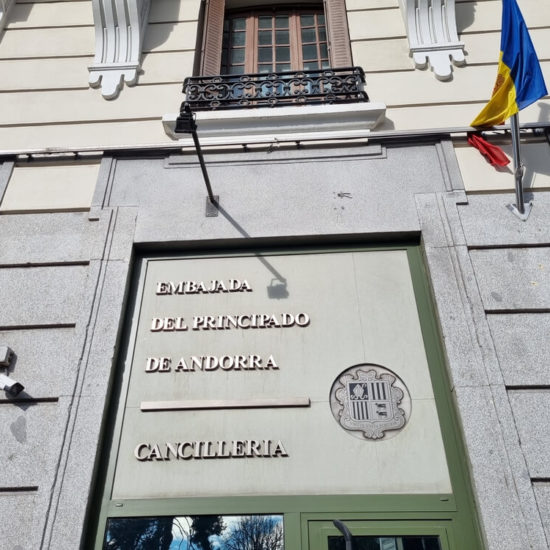
A common mistake is to assume that every country has an embassy or consulate in the country where its citizens reside. This is not the case, and even less so in a microstate such as Andorra. Foreign diplomatic representation in the country is limited. For many expatriates, the embassy or consulate responsible for Andorra is located in a neighbouring country.
In practical terms, two people living in the same building in Andorra la Vella may have to handle their consular procedures in two different cities simply because they have different nationalities. The first thing to do after settling in is to identify precisely which diplomatic representation is responsible for Andorra residents of your nationality.
You should not automatically assume that this will be the geographically closest consulate. Consular jurisdictions are defined by each country. A consulate located in Barcelona may be responsible for one nationality, while another embassy in Madrid, Paris or elsewhere may be responsible for citizens of another country living in Andorra.
This should be checked on the official website of your country’s Ministry of Foreign Affairs or diplomatic network.
What does the absence of your country’s consulate in Andorra change?
In everyday life, generally very little. The consequences mainly arise when a procedure requires you to be physically present. Much of the administrative preparation can now be completed remotely: checking procedures, downloading forms, booking appointments, submitting certain information or communicating with consular services.
However, some formalities may require travel. This is particularly the case when identity verification, the collection of biometric data or personal attendance is mandatory.
Take a simple example. Your passport is about to expire. You check the procedure and discover that the authority responsible for your place of residence requires you to be present when submitting the application. You then need to factor into the renewal process not only the document issuance time, but also the time needed to obtain an appointment and travel to the consular office.
This is precisely why, when living in Andorra, it is better not to wait until the final weeks of a document’s validity before starting the process.
What services can a consulate provide?
The exact responsibilities depend on the country and the consular office concerned. A consulate is not a universal administration capable of resolving every difficulty encountered abroad. It can generally provide information and assistance to its citizens with certain procedures relating to identity and travel documents, civil status or consular assistance. It may also intervene when a citizen faces a serious situation abroad, such as an arrest, an accident or the loss of their documents.
This does not mean, however, that a consulate can replace the Andorran authorities, a lawyer, an insurance company or a bank. This distinction is important. If your problem concerns your Andorran residence permit, you will primarily need to contact the relevant Andorran administration. If it concerns your national passport, your consulate or embassy will generally be the appropriate point of contact.
As the services available, supporting documents, fees and processing times may change, avoid relying on amounts or timeframes presented as universal. The official procedure of the relevant consular office remains the reference.
French and Spanish citizens: procedures that are generally more accessible locally
For French and Spanish citizens, the institutional proximity of their countries to the Principality makes access to a number of consular services easier. However, this does not mean that all procedures can be completed immediately or without an appointment. Before travelling, check the official page corresponding specifically to your procedure.
Check whether an appointment is mandatory, which original documents must be presented, whether photographs are required, which payment methods are accepted and whether collecting the document requires you to be physically present again. Taking a few minutes to check this information will often save you an unnecessary trip.
Belgian, Portuguese, British and other European citizens
For citizens of other European countries, the situation varies more significantly.
The appropriate approach is to identify the officially competent diplomatic representation for people residing in Andorra. It may be located in Spain, France or another consular jurisdiction, depending on how your country’s diplomatic network is organised.
When making initial contact, immediately specify that you are a resident of Andorra. This allows the consular service to confirm that it is indeed responsible for your case and provide you with the appropriate procedure.
This precaution is particularly important when renewing a passport, registering a civil status event or completing any procedure that requires an appointment.
What about citizens of countries outside the European Union?
The principle remains the same: you need to determine which embassy or consulate of your country has territorial jurisdiction over Andorra.
In some cases, the relevant diplomatic representation may be relatively far away. It therefore becomes even more important to anticipate document renewals and keep the contact details of the consular emergency service readily available.
You should also avoid assuming that you can automatically seek assistance from another country. Cooperation mechanisms may exist in certain circumstances, but they depend on your nationality, location, applicable agreements and the nature of the emergency. If in doubt, only your country’s diplomatic authorities can officially tell you which representation to contact.
What should you do if your passport is lost or stolen?
This is probably the situation that best illustrates the value of planning ahead. If your passport is lost or stolen, start by following the instructions of the local authorities and your consular representation. Depending on the circumstances and your nationality, you may need to report the loss or theft to the authorities before a replacement or travel document can be issued.
Then contact the officially competent diplomatic representation and clearly explain that you are a resident of Andorra, where you are currently located and whether you have any travel planned in the near future.
Having a digital copy of your passport can make certain checks easier. It obviously does not replace the original document, but keeping a secure copy of your main identity documents is a useful precaution when living abroad.
It is also advisable to keep the contact details of the consular emergency service separately. If your phone containing all your information disappears at the same time as your wallet, you will appreciate having prepared a backup solution.
What should you do in a genuine emergency in Andorra?
In the event of an accident, immediate danger or a security issue, the first point of contact is generally not the consulate. It is the Andorran emergency services. Once the immediate situation has been dealt with, your embassy or consulate can be contacted when the circumstances justify consular assistance. This is particularly relevant in cases of arrest, serious accident, major hospitalisation or a situation requiring relatives to be notified or information to be obtained about the available procedures.
However, it is important to keep the limits of consular assistance in mind. A consulate can provide information, facilitate certain contacts and carry out the functions provided for under applicable law, but it cannot overturn a decision by the Andorran authorities or exempt you from local laws.
For emergency numbers and the contact details of the relevant services, use the information published by the Andorran authorities and verify it when you need it.
How can you effectively prepare for a consular procedure from Andorra?
Most consular complications are caused less by the complexity of the procedure itself than by a missing document or a misunderstanding of the process. Before arranging travel, read the consular office’s instructions in full. Make sure that it is indeed responsible for residents of Andorra and check the validity of the required documents.
Pay attention to requirements concerning photographs, civil status documents and proof of address. One administration may require an original where another accepts a copy. A document may need to be recent, translated or authenticated.
When contacting the consulate, there is no need to write a lengthy message. A precise request will generally result in a more useful response. State your nationality, your residence in Andorra, the procedure you need and the specific issue you are trying to resolve.
Do you need to have your documents translated?
It depends on the authority receiving the documents and the document concerned. For a procedure with the Andorran authorities, certain foreign documents may require an official translation. For a procedure with your own consulate, the rules may be different.
Do not systematically have all your documents translated before knowing what is actually required. An official translation involves a cost and may sometimes need to be completed according to specific requirements in order to be accepted. When a translation is required, check which type of translator is accepted and whether an apostille or legalisation must be completed before or after the translation.

Realize your expatriation project without further delay!
Make an appointment
Expatriate communities: useful, but no substitute for official sources
Expatriate groups can be extremely useful when you arrive in Andorra. They can help you understand how an appointment works in practice, find a translator, learn about local practices or simply exchange information with people who have experienced the same problem. This shared experience has real practical value.
However, it should remain complementary to official information. Someone who renewed their passport two years ago may describe their experience perfectly while providing a procedure that has since become outdated.
The right approach is to use personal accounts to understand how things work in practice, then check the administrative requirements with the relevant authority before taking action. This remains particularly important for matters relating to immigration, residence permits, identity documents, administrative obligations or legal deadlines.
Steps to take before moving to Andorra
Ideally, you should deal with the consular issue before even moving. Identify the embassy or consulate responsible for your nationality in Andorra and save its official contact details. Check the expiry date of your passport and those of your family members. If any of them needs to be renewed soon, it may be much easier to take care of it before leaving.
Then keep secure copies of your main documents and store the contact details of the Andorran authorities and your diplomatic representation somewhere easily accessible. If you are moving with your family, make sure that someone else also knows where this information can be found. In an emergency, this small precaution can make a real difference.
Living in Andorra without an embassy from your country
The absence of diplomatic representation from your country in Andorra may seem concerning when preparing for your move abroad. In practice, it is primarily an organisational constraint. The key is to know, before you need it, which authority is responsible for your nationality.
For procedures relating to your Andorran residency, contact the authorities of the Principality. For your passport, civil status or a request for consular assistance, refer to the official information provided by your country. And whenever travel outside Andorra is required, plan it sufficiently far in advance to avoid turning an ordinary administrative procedure into an emergency.