
How does the state work in Andorra and who leads the country?
Andorra has one of the most distinctive political systems in Europe. Unlike most states, the Principality has not one but two heads of state: the co-princes. This particularity is not merely a historical curiosity. It lies at the heart of the country's history and remains embedded in its constitutional system.
However, the co-princes do not govern Andorra on a day-to-day basis. Since the adoption of the Constitution in 1993, the Principality has been a parliamentary democracy in which the government conducts national policy under the supervision of the Consell General, the Andorran parliament.
To understand who actually leads Andorra, it is important to distinguish between the role of the heads of state, the head of government and parliament. This current system is the result of several centuries of political compromises that have enabled this small Pyrenean territory to preserve its identity and institutions.
The history of Andorra, at the origin of a unique political system
Located in the Pyrenees between France and Spain, Andorra developed its political system in an environment where several powers once competed for influence.
The Andorran tradition notably associates Charlemagne with the historical origins of the country. According to a story passed down through the centuries, the emperor granted protection to the inhabitants of the valleys as a reward for their participation in battles against the Moors. However, this account belongs more to Andorran historical tradition than to an event whose details have all been established with certainty.
The real institutional turning point came in the 13th century. At the time, rights over the Andorran valleys were the subject of rivalry between the Bishop of Urgell and the Count of Foix. Rather than allowing the conflict to continue, the two parties reached an agreement. The paréages of 1278 and 1288 established the division of their rights and authority over Andorra. These medieval agreements contain the roots of the current co-principality.
This compromise profoundly shaped the country's history. For centuries, Andorra maintained a unique political organisation between its two powerful neighbours without simply being absorbed by either one. The institutions have naturally evolved considerably since the Middle Ages, but this principle of shared authority remains visible today.
How has Andorra's political system evolved?
For much of its history, Andorra obviously did not operate as a contemporary parliamentary democracy. Its organisation was based on feudal rights, local institutions and authority jointly exercised by the two co-lords.
An important step was taken in 1419 with the creation of the Consell de la Terra, generally regarded as the predecessor of today's Consell General. Representatives of Andorran communities gradually gained an institution responsible for defending and administering the interests of the valleys.
The system continued to evolve, particularly from the 19th century onwards and throughout the 20th century. Political representation expanded and institutions gradually modernised. However, the decisive transformation came in 1993.
That year, Andorrans approved the country's first written Constitution by referendum. Andorra was then clearly established as a democratic and social state governed by the rule of law. The Constitution established the separation of powers, defined fundamental rights and clarified the roles of the co-princes, the Consell General, the government and the judiciary. The country's institutional heritage was therefore not abolished. Instead, it was incorporated into a modern constitutional system.
Who leads Andorra today?
This is probably the point that causes the most confusion. Andorra has two heads of state, but they should not be mistaken for two heads of government. The Constitution maintains the co-principality: the two co-princes jointly exercise the role of head of state.
One of the co-princes is the Bishop of Urgell, in Catalonia. The other is the President of the French Republic. This second position is the historical successor to the rights once held by the Counts of Foix, which were subsequently passed to the French Crown and then to the French head of state.
The co-princes are therefore an essential part of the country's institutions, but their role is defined by the Constitution. They primarily represent the continuity and independence of the Andorran state and take part in several institutional acts provided for by the Constitution.
Day-to-day executive power, meanwhile, belongs to the Govern d'Andorra. It is headed by the cap de Govern, or head of government. The head of government conducts national policy alongside the ministers and exercises the executive responsibilities required for the day-to-day functioning of the state.
This distinction provides a simple answer to the question, "Who leads Andorra?" The country has two co-princes as heads of state, while the day-to-day conduct of national policy falls to the head of government and their cabinet.
What exactly is the role of the co-princes?
The role of the co-princes is primarily institutional and constitutional. Their existence guarantees the continuity of the particular political system chosen by Andorra. They have a specific role in the sanctioning and promulgation of laws and in several institutional procedures defined by the Constitution. They also have responsibilities related to the representation of the state. However, they do not directly administer Andorran public policies. They do not independently decide the country's budget, taxation, education or economic policy.
The system is based precisely on this division of responsibilities. The co-princes embody the state and its historical continuity, while democratically constituted institutions exercise political and legislative responsibilities.
It would also be misleading to simply describe this as Franco-Spanish co-sovereignty. The episcopal co-prince is the Bishop of Urgell, not the King of Spain or the Spanish government. Andorra is a sovereign state with its own institutions. This distinction is essential to understanding how its political system works.
The Consell General, Andorra's parliament
At the heart of democratic life is the Consell General, the Principality's unicameral parliament. It has 28 members, known as consellers generals. Their electoral system seeks to balance two principles: ensuring fair representation of the country's seven parishes while also reflecting voters' choices at the national level. Some seats are therefore allocated through parish constituencies, while the others are elected through a national constituency.
The Consell General passes laws and approves the budget, oversees the government's actions and plays a key role in major legislative decisions. It also has a decisive role in appointing the head of government. Following legislative elections, the parliament elects the cap de Govern in accordance with the rules laid down by the Constitution. The head of government then exercises executive power alongside the ministers they appoint.
Andorra's political system is therefore much closer to that of a conventional European parliamentary democracy than its title of "Principality" might suggest.
The seven parishes and the role of the Comú
To understand how the country is administered, it is also necessary to look at the local level. Andorra is divided into seven parishes: Canillo, Encamp, Ordino, La Massana, Andorra la Vella, Sant Julià de Lòria and Escaldes-Engordany. Each parish has a local administration known as a Comú. These municipal institutions are responsible for various local matters and play a direct role in organising the territory.
This local autonomy is far from insignificant. It reflects Andorra's history, which was long structured around its valleys and communities. Even after the modernisation of the state, the parishes remain an important part of the country's political and administrative identity.
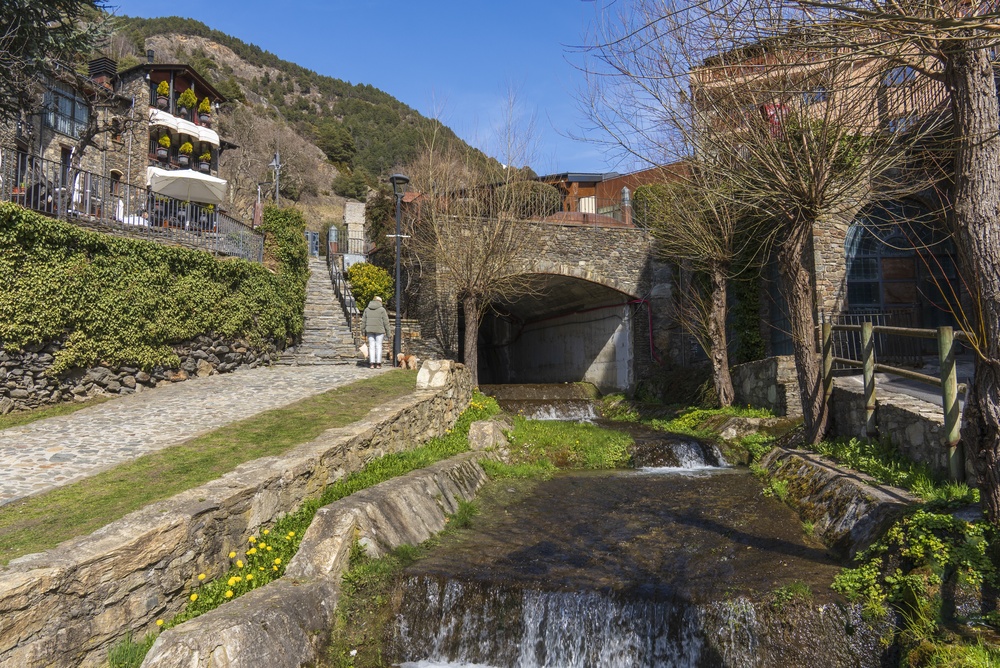
Andorra's institutional system is therefore based on several complementary levels: the co-princes represent the role of head of state, the government exercises executive power, the Consell General exercises legislative power and the Comú administers a significant part of local affairs.
The 1993 Constitution and the democratisation of Andorra
The Constitution adopted in 1993 forms the basis of the state's current system. It defines Andorra as an independent, democratic and social state. It clearly establishes the powers of its various institutions. It also enshrines fundamental rights and freedoms and provides for the separation of powers.
Legislative power belongs to the Consell General. The government exercises executive power. Judicial authority is independent.
The Andorran judicial system comprises several courts. The Tribunal de Corts plays an important role primarily in criminal matters, but it is not, by itself, "the highest court" in the entire Andorran judicial system. The system also includes the Tribunal Superior de Justícia and the Tribunal Constitucional, whose areas of jurisdiction are distinct.
This institutional structure is important because it demonstrates how far modern-day Andorra has moved away from a feudal system, even though it has retained the co-principality inherited from its history.
Is Andorra a member of the European Union?
Andorra is not a member of the European Union. Nevertheless, it maintains close economic and institutional relations with Europe, particularly with France and Spain. The Principality uses the euro under a monetary agreement with the European Union and can issue its own euro coins under the conditions established by that agreement.
Andorra has also been a member of the United Nations since 1993 and the Council of Europe since 1994. Over recent decades, the country has considerably strengthened its international cooperation, particularly in the areas of taxation, finance and transparency. This development has accompanied the transformation of its economic model and its desire to become more closely aligned with international standards.
This international openness does not undermine its sovereignty. On the contrary, it demonstrates how a microstate can preserve its distinctive institutions while participating in major international organisations and European cooperation mechanisms.

What is the link between the institutions and Andorra’s appeal?
Institutional stability is one of the factors contributing to Andorra’s appeal, but it is not enough to explain it on its own.
The country also benefits from its location between France and Spain, generally more moderate taxation than in many European countries and a service-oriented economy. Tourism, retail, financial activities, real estate and, more recently, the development of new digital sectors all play an important role.
Winter sports, hiking, thermal tourism and shopping attract many visitors every year. In a territory covering only a few hundred square kilometres, this level of visitor activity naturally has a significant impact on the economy and land-use planning.
However, it is important not to reduce Andorra to its tax system or tourism. Regulatory developments, relations with the European Union, housing constraints, the protection of natural areas and economic diversification are all part of the challenges that the country’s institutions must address.
This is precisely where the functioning of the state becomes tangible. Behind the historical uniqueness of the co-principality lies an administration that must deal with the same major economic, social and environmental issues as other European countries.
Why is Andorra’s political system so distinctive?
Andorra’s uniqueness lies less in having two leaders than in the way several centuries of history have been incorporated into a contemporary democracy.
The medieval paréages laid the foundations for shared authority. Andorra’s representative institutions gradually developed over time. Finally, the 1993 Constitution transformed this heritage into a modern legal framework based on popular sovereignty, the separation of powers and the rule of law.
Today, the co-princes embody this historical continuity, while the Consell General and the Govern ensure the democratic functioning of the country. It is this combination that makes Andorra difficult to compare directly with its neighbours. The Principality did not abandon its history in order to become a modern state. Instead, it gradually adapted its historic institutions to the requirements of a parliamentary democracy.
To understand the country, one essential distinction should be kept in mind. The co-princes are the two heads of state, but the government conducts national policy under the supervision of parliament. Behind an institutional structure inherited from the Middle Ages, Andorra therefore operates as a contemporary constitutional state.